El Salvador
Table of Contents

I just came back from three weeks in El Salvador. You land to a giant sign that says "El Salvador, the Land of Smiles," which might be a stretch. Summer means rain most afternoons; thunderstorms drift through most evenings for an hour or two.
I spent three weeks in the city for the Fiestas de Agosto and San Salvador's 500th anniversary of its founding. I came for the procession and stayed for small things: pupusas on paper, Cadejo blond ale cold, guards choreographing gates. It felt safe in the center and easy to move. The coast and a volcano sit a short drive away. These notes are about the capital, plus a hike and a beach run.
San Salvador is not really a walkable city beyond the center, which closes early. Barbed wire separates most neighborhoods, and most people get around by motorcycle or car. Like parts of the Middle East, wealthier areas self-segregate into small malls and shopping zones, while walkability is less prized. There are token bike lanes in some wealthy areas, but it's not easy to walk around.
Military presence is everywhere. Although none of them checked my ID1, soldiers are posted across the city.
1. Fiestas de Agosto
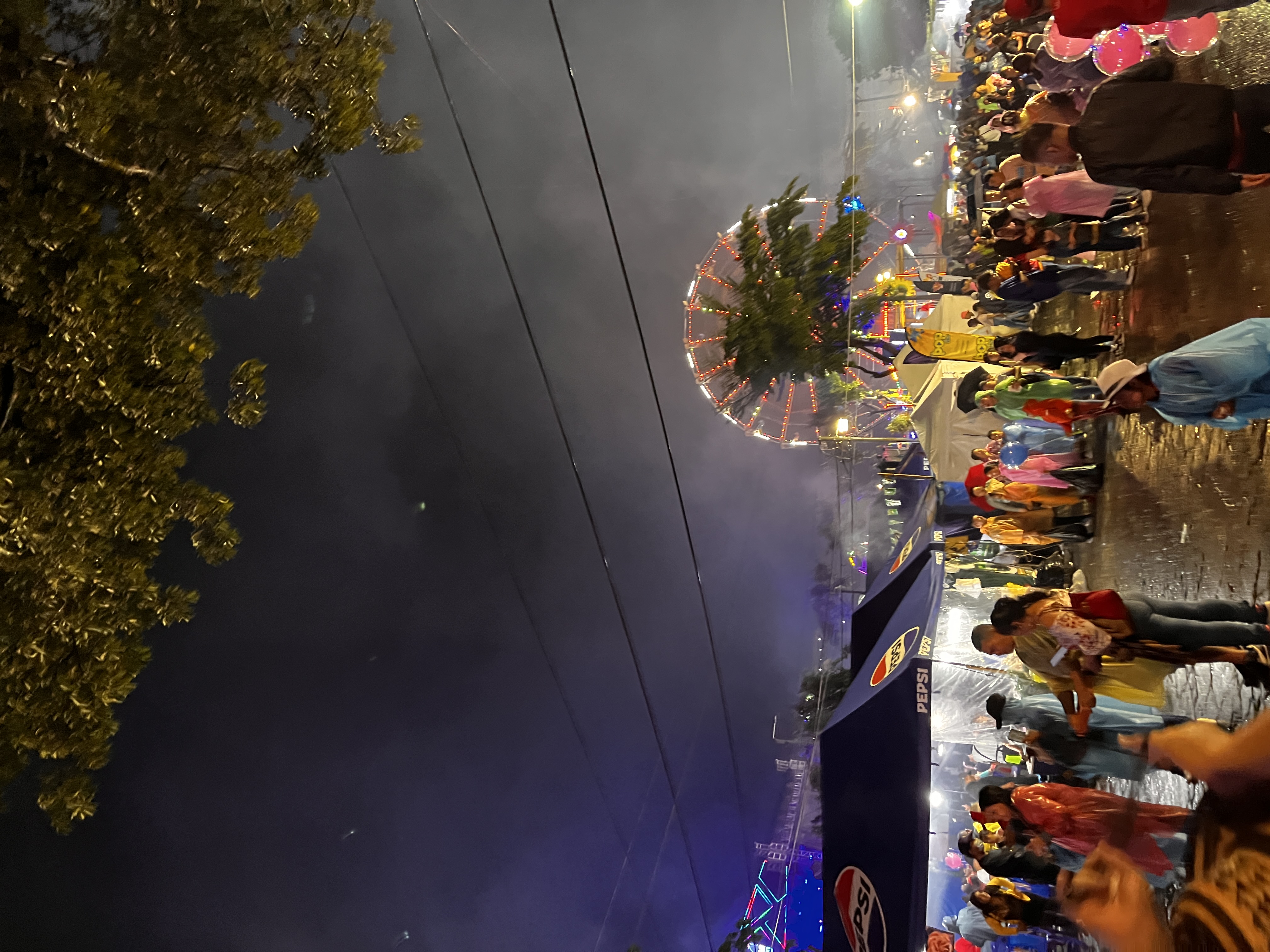
Sivarland at night. Rain slick, smoke, Ferris wheel lit.
I came into the festival by the southern gate around 8pm. First hit was sugar and oil from churros, then gunpowder. Generators droned. Cables sagged over the walkway. A kid, fingers sticky, bumped into me and the parent shot me an apologetic look.
Soldiers are present without hurry. Long guns slung, hands light on the grip. At the gate, they asked three questions, looked at my bag, and waved me through. The choreography at gatehouses is quick: a nod, a clipboard, a latch.
Sivarland, the carnival zone, runs loud for six days at the start of August2. Ferris wheels, drums, fireworks, vendors in the street. The point is to celebrate the Transfiguration of Christ, with the fiesta leading up to the event mass at the metropolitan church.

“Elotes Locos,” “Papitas Fritas,” “Churros Españoles.” Prices in marker, cables overhead.
I walked the loop twice looking for a beer and failed. Drinks were soda and water; I gave up and had a cold one at home. Maybe that’s policy during the fair. There was a concert going on as well, and carnival rides and families gathered everywhere. Circus animals, and plenty of military strolling around.
It’s a carnival threaded with Jesus: banners on ride fronts, a small altar by the speakers, a prayer before the fireworks.
1.1. Mass on the 6th

Gathered at mass.
The Catedral Metropolitana filled for the Transfiguration. I stood for hours in sun and shade. The homily circled Romero and opened with a prayer for migrants in the United States. People shaded their faces with programs and parasols. Water sellers threaded the aisle. A woman beside me whispered each response half a beat early. When the final hymn started the square sang back.
The mass was reserved. The priest focused on Salvadorans in the US in light of recent deportations, then transitioned to Romero and the struggles of priests past. I've been to many masses in Mar Yousef in Erbil, and this one felt tame in comparison.
The cathedral square is big, with one of those small parks that has a few water fountains from the ground for children to play in. There's a variety of good coffee shops around3 the square itself, framed by the gigantic National Library4 and the National Palace. It's a relaxing area. Later in the day, I trekked back inside the cathedral, and it's surprisingly sparse. The cathedral still has two large portraits of Romero hanging on the side:
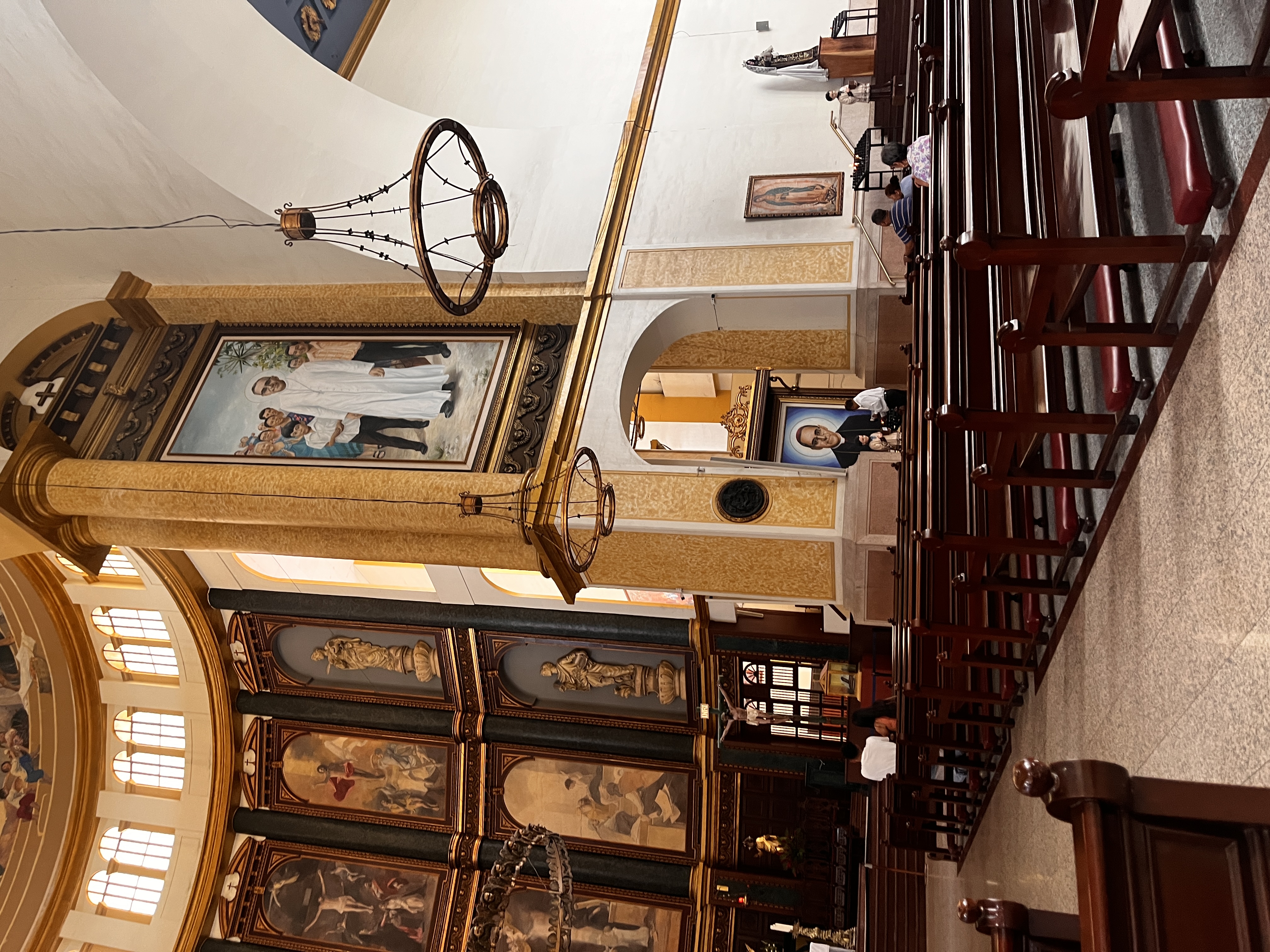
Romero is present in the air, not just in museums. The priest quoted him twice; the crowd answered both times. This was particularly surprising to me, as I had vaguely known about his influence, but never seriously considered it. Matt Eisenbrandt puts it5:
Óscar Romero is one of the towering heroes in El Salvador’s history whose influence transcends the borders of that small country. Romero’s impact can be measured quantitatively, by the 100,000 mourners who risked their lives to attend his funeral, or by the disturbing truth that his assassination accelerated El Salvador’s descent into civil war.
2. Romero
He is everywhere: bus decals, murals, keychains at the cathedral gate. The strongest encounter was at the hospital chapel where he was killed. A small room holds his vestments and diary pages. The guide speaks softly and points with two fingers. Outside, a white rose bush is kept trimmed. The shadow he casts is practical as much as holy: quotes on banners, names on parish flyers, a tone of moral certainty in casual talk.
I found the Museo de la Palabra y la Imagen to be the default memory/genocide museum. While small compared to the Art Museum or the Dr. David J. Guzmán National Museum, it had a dedicated exhibition on Romero and the civil war.
The Romero section was filled with photos of his life, including the elephant he met at the San Salvador Zoo. Photos of him preaching, busts of his face, his family, his notes. The whole space functioned as a shrine, and that's striking because many religious figures people strive to emulate are far away (temporally speaking). Kobo Daishi, Anastasia, and Hussein exist as canonical figures, but Romero exists in color photographs. You can walk the same paths he did, go to the same restaurants he did. Many people who are still alive today remember him.
There's an art to the construction of a saint, especially one that transgresses borders. Romero functions as a politicized sainthood, and I'd almost place him alongside Sheikh Abdesslam Yassine, the Moroccan cleric who wrote Al-Islam aw al-tufan6 to admonish King Hassan II. This form of sainthood is active: Yassine set himself against an oppressive regime, and both he and Romero cast long shadows with religious authority contrasted against political power.
Saints are made by the people before they are made by institutions, which you can see in Romero's late canonization in 2018. But Salvadoran society is saturated with Romero, which raises the question of how a living saint becomes a martyr when reproductions and evidence of their life are so obvious and near. Martyrdom is almost easier without photos and documents; you can dramatize, reproduce, replay the saintly life into thematic principles. But Romero and Yassine are difficult to shape or dramatize, as their lives press so close to believers.
Self-censorship is a spectrum, but I had expected there to be significantly less space dedicated to the civil war than there actually was. Numerous photos, faces in black-and-white prints of fighters, and an old classroom kept as it was. A small candle monument to those who died, and an entire gigantic room dedicated to a reproduction of Radio Venceremos.

Reproduction of the broadcasting room.
Radio Venceremos was one of the largest anti-government radio stations of the FMLN. Famously, the government tried so hard to shut them down that radio broadcasters used themselves as bait to lure a government general, and shot down his helicopter. It was on Venceremos that the end of the civil war was broadcast. This room is remarkable as well in its completeness, one can easily see that this room was carved with care.
3. Misc
I was vaguely aware that Bukele was Palestinian, but I didn't realize how much emigration of Palestinians occurred to El Salvador until I walked by Schafik Hándal's massive grave.

Handal was the general secretary of the FMLN, and fought against the government and then eventually transitioned to becoming a politician.
It's in the food too; I kept seeing quibe (kibbeh) on menus and even a restaurant called "Matkub." The graves of Palestinian resistance fighters are all over the necropolis too.
4. Wrap
I liked El Salvador. It's a small country, so you can cross it in a few hours, but there's surprising depth in the politics and history. I especially enjoyed the necropolis; it resembles the one in Buenos Aires.
- More Photos: Link
Footnotes:
In Lebanon and Iraq, I'd expect checkpoints staffed by the military to stop me and check IDs. I hit zero checkpoints in El Salvador.
“Sivar” is a local nickname for San Salvador.
Salvadorans are proud of their coffee production and culture.
Donated in part from the Chinese apparently.
Eisenbrandt, Matt. Assassination of a Saint: The Plot to Murder Óscar Romero and the Quest to Bring His Killers to Justice. University of California Press, 2017.
"Islam or the Deluge"